
Adamawa Region
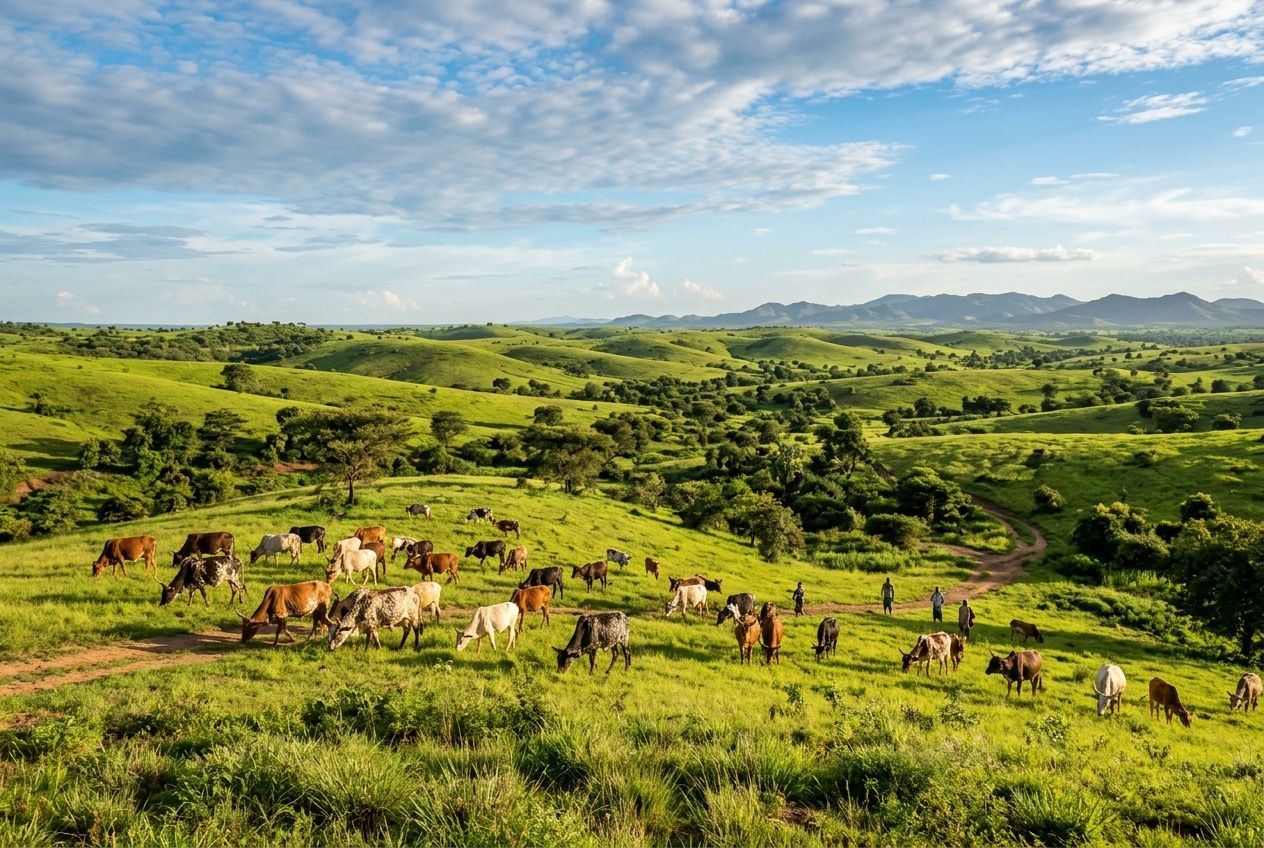
Cameroon’s water tower, its leading cattle basin and the end of the railway line.
Created by the decree of 22 August 1983, the Adamawa Region covers 63,701 km², about 13.5% of the national territory: it is the country’s third-largest region. Around Ngaoundéré, its capital, the high plateaux make it Cameroon’s leading cattle-raising area. As the terminus of the Trans-Cameroon railway, it is the transshipment point for goods bound for the north of the country, Chad and the Central African Republic.
- 63,701 km²
- Area
- 1.3 M
- Inhabitants, approximately
- 2.2 M
- Head of cattle
- 180,000
- Cattle exported a year
- 1 bn t
- Of estimated bauxite
- 30,000
- Students at the University of Ngaoundéré
13.5% of the territory, 5 divisions
Density of about 20 inhabitants per km²
35 to 40% of the national herd
To southern Cameroon and neighbouring countries
Alumina content above 45%
4 faculties and 4 schools
The region’s strengths
- The country’s leading cattle area: over 2.2 million head, 35 to 40% of the national herd
- Terminus of the Trans-Cameroon railway: transshipment to northern Cameroon, Chad and the CAR
- Minim-Martap and Ngaoundal bauxite deposits: over one billion tonnes estimated
- University of Ngaoundéré: over 30,000 students and leading engineering schools
Major projects
- Mining of the Minim-Martap and Ngaoundal bauxite
- A rail link of about 130 km to the CAMRAIL network
- Development of 120,000 ha of irrigated land (Adamawa, North, Far North)
Geography and administration
Cameroon’s third-largest region
Adamawa covers 63,701 km², with a relatively low density of about 20 inhabitants per km².
Five divisions and 21 subdivisions make up the region. The Regional Council has been operating since December 2020; the region has one city council, Ngaoundéré, and 21 councils.
The population, young and cosmopolitan, brings together Fulani, Mbum, Gbaya, Tikar, Kutin and Kandar communities, joined by traders and herders from other regions and neighbouring countries.
Vina
Capital Ngaoundéré, 8 subdivisions. Economic, university and administrative centre.
Djérem
Capital Tibati, 2 subdivisions. Inland fishing and rail transit.
Faro-et-Déo
Capital Tignère, 4 subdivisions. Bordering Nigeria, with strong pastoral and mining potential.
Mayo-Banyo
Capital Banyo, 3 subdivisions. A farming, livestock and fishing area.
Mbéré
Capital Meiganga, 4 subdivisions. International transit to the Central African Republic.
Livestock and agro-industry
The country’s leading cattle-raising area
The cattle herd is estimated at over 2.2 million head, or 35 to 40% of the national herd.
Known as Cameroon’s water tower, Adamawa owes its pastoral vocation to its vast highland pastures. It supplies beef to most of the major urban centres in the south of the country.
Over 180,000 cattle are shipped each year to southern Cameroon and neighbouring countries; the region also has over 150,000 sheep and goats.
Cattle
Over 2.2 million head on the highland pastures.
Markets
Over 180,000 cattle shipped a year to the south and neighbouring countries.
Small ruminants
Over 150,000 sheep and goats.
Mineral resources
World-class bauxite deposits
The Minim-Martap and Ngaoundal reserves are estimated at over one billion tonnes of bauxite with a high alumina content (above 45%).
Mining these deposits and connecting them by rail is one of the country’s greatest levers for industrial development. A planned line of about 130 km is to link the sites to the CAMRAIL network to carry the ore.
Minim-Martap and Ngaoundal
Over one billion tonnes estimated.
Rail link
About 130 km to build to the CAMRAIL network.
Transport and strategic position
The transshipment point for Chad and the CAR
Ngaoundéré is the terminus of the Trans-Cameroon railway, operated by CAMRAIL.
Goods are transferred there from rail to road to reach northern Cameroon, Chad and the Central African Republic. Mbéré division handles international transit to the CAR.
Rail
Terminus of the Trans-Cameroon railway in Ngaoundéré.
Road
National road 1, linking the south of the country to the north.
Air
Ngaoundéré airport.
Higher education and health
A university capital
The University of Ngaoundéré, founded in 1993, has over 30,000 students, four faculties and four schools.
It is known for its engineering schools, including the National Advanced School of Agro-Industrial Sciences (ENSAI) and the University Institute of Technology. The region has over 600 public and private primary and secondary schools.
ENSAI and the IUT
Leading engineering schools for agro-industry.
Health
A regional hospital centre and a regional hospital in Ngaoundéré, 9 district hospitals and over 120 medical and health centres.
Tourism, environment and culture
Mountain lakes, waterfalls and lamidates
The region offers crater landscapes, mountain lakes, waterfalls and a national park.
The lamidates of Ngaoundéré, Tignère and Banyo keep a living cultural heritage, marked by fantasias during traditional and religious festivals.
Lake Tison
A crater lake near Ngaoundéré.
Mbam et Djérem National Park
A protected area between savannah and forest.
Lamidates and fantasias
Ngaoundéré, Tignère and Banyo.
Investing in the region
Sectors to explore
Adamawa combines the country’s largest cattle herd, world-class bauxite deposits, the rail terminus serving Chad and the CAR and a university known for its engineering schools.
-
Livestock and meat
The country’s leading cattle basin
-
Mining
Minim-Martap and Ngaoundal bauxite
-
Rail-road logistics
Transshipment to Chad and the CAR
-
Irrigation
Irrigated land
-
Training
Agro-industry, engineering
-
Nature tourism
Lakes, waterfalls, national park
FECIS connects project owners, local authorities and financiers.
Next edition: 3 – 5 November 2026, Motel PLAZZA, Garoua.
Sources : Figures from the study “Investment assets and opportunities in the Septentrion 2026”. Indicative data, dated according to their sources; they do not constitute a validated opportunity.